
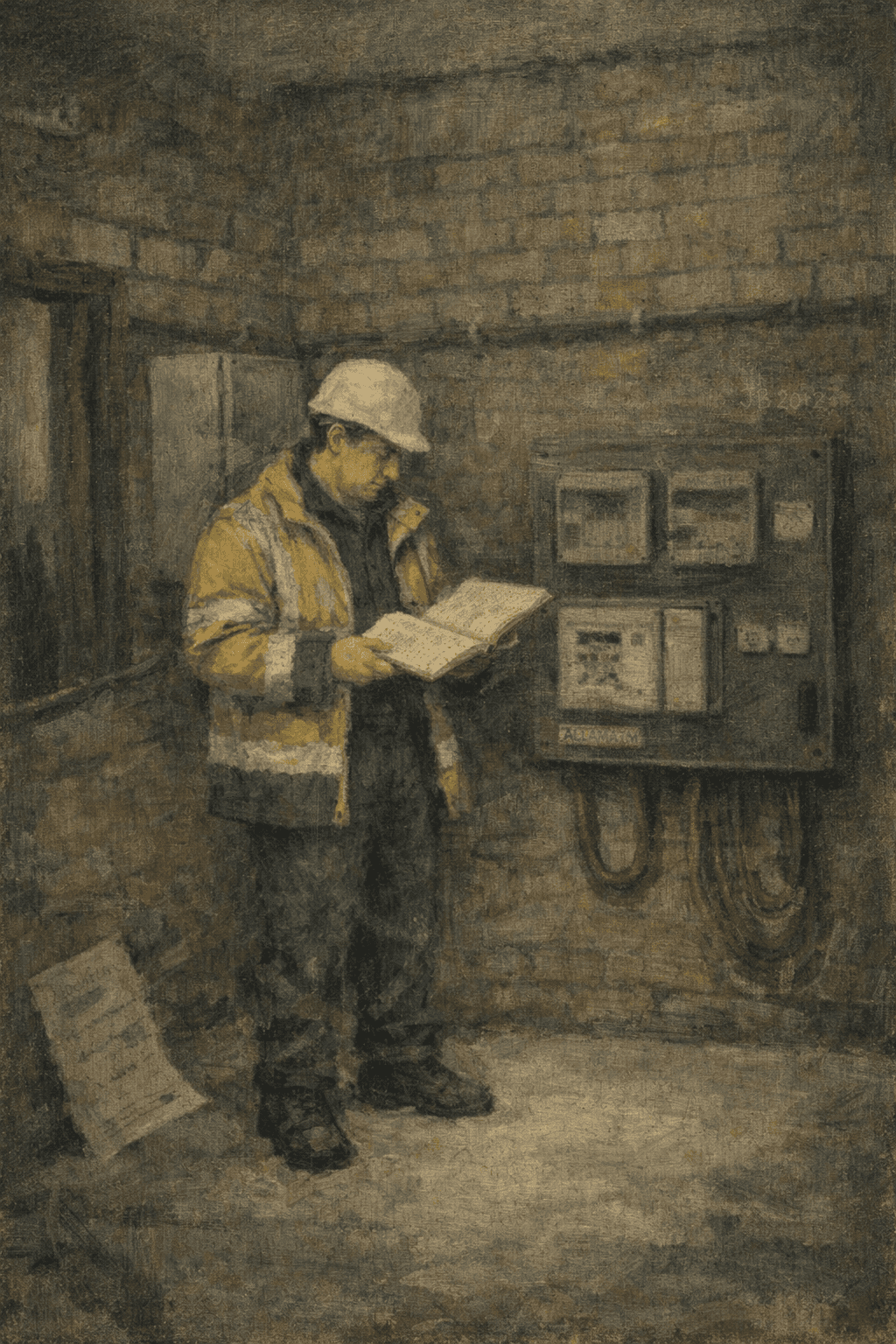
If I walked into a secondary substation anywhere in the country tonight, I could predict with surprising accuracy what I’d find. In Manweb it’s on top of the battery cabinet, in Norweb it’s usually on top of the Ring Main Unit. There would be an A4 logbook worn at the edges, it pages softened by decades of handling. Inside it are handwritten entries that would track every visit, operation, fuse replaced and test completed. I would know who was last there, what they did and whether anything remained outstanding. If the substation had seen little activity over the years I might even find entries from the 1950s, ink fading but still a legible recording of the work of engineers long since gone. One logbook, quietly carrying seventy years of continuity.
We tend to treat rigidity as a flaw. We say rigid systems can’t innovate, rigid processes slow things down, rigid structures belong to the past. But anyone who has worked inside a system responsible for public safety knows that rigidity is not the enemy of progress it is the precondition for reliability. Rigidity protects design integrity, workforce consistency, operational safety and long-term asset health. It enables scale. It is not friction, it is resilience.
This is clearest in safety-critical environments, where improvisation is not ingenuity but risk. In the grid, the control engineer is the authorised person decides what happens on a site, who can operate, when it is safe and under what conditions. The quiet nickname that all crafts use for this role “God” is not reverence, nor hierarchy for its own sake. It is acknowledgement that when errors carry physical consequences, process is not an administrative preference; it is a survival mechanism.
Rigidity also protected continuity. I remember sitting with an engineer at a training event, reflecting on the birth of his son. He told me he’d attended an LV fault earlier that week, replaced the fuses and updated the logbook. The logbook was older than he was. “When I’m gone,” he said, “someone else will come, replace the fuses and write their name in that same book. The process keeps the place running.” He wasn’t talking about nostalgia. He was describing inheritance the way structure carries systems through time, even as the people change.
Decentralised energy has not yet found an equivalent inheritance mechanism. Not because contractors lack discipline, but because they operate in a context where stability is harder to achieve. Their world is shaped by fluctuating demand, competitive pressures, shifting teams and commercial realities the centralised world never had to contend with. Expecting continuity without giving them the framework to sustain it is unrealistic.
Understanding why rigidity mattered in centralised systems means understanding the nature of electricity itself: miles of metal carefully rated to carry only so much energy before heat, load or time threatens its integrity. Predictability is the foundation of safe operation. A network operator must know how assets behave, how they age, how they were installed and how best to repair them when they fail. They must know the condition of equipment, the maintenance it requires and the limits it can tolerate. Rigid processes created that predictability not through superiority, but through consistency.
This was equally true of the craft. Before I understood the distinctions between jointers, linesmen and fitters, I heard them referred to simply as craftsmen. And it is an accurate word. Craft is built through repetition, refined through practice and made scalable only through method. When a process is rigid, competence becomes consistent. When a process becomes optional, competence becomes variable not because people don’t care, but because variation is what systems produce when structure is absent.
You see this in rooftop solar. The failures that appear repeatedly across the country are rarely mysterious. They cluster around the same themes: mismatched connectors, inconsistent torque, loose terminations, cable management shortcuts, skipped tests, incomplete documentation. These are not failings of individuals. They are symptoms of a craft being stretched across a landscape that has not yet built the shared method it deserves.
Yet rigidity alone cannot guide the future. The centralised grid must remain stable, predictable and deeply structured. Decentralised generation must remain flexible, innovative and fast-moving. Neither side can simply mimic the other. The challenge is finding the balance: a rigid, highly reliable grid working alongside a creative, decentralised generation layer connected by a method layer that ensures clarity, communication, safety and learning.
Without some rigidity, decentralisation becomes fragility.
With too much rigidity, decentralisation becomes impossible.
The future depends on our ability to combine the strengths of both.
What we lost in the transition from centralised to decentralised energy was not innovation. It was the structure that once made reliability inevitable. The old world gave us discipline by default. The new world must build discipline by design.
If we do that, if we give contractors the shared methods, shared tools and shared language they’ve never been given, we can create a decentralised system as reliable as the one that came before it, but far more capable.