
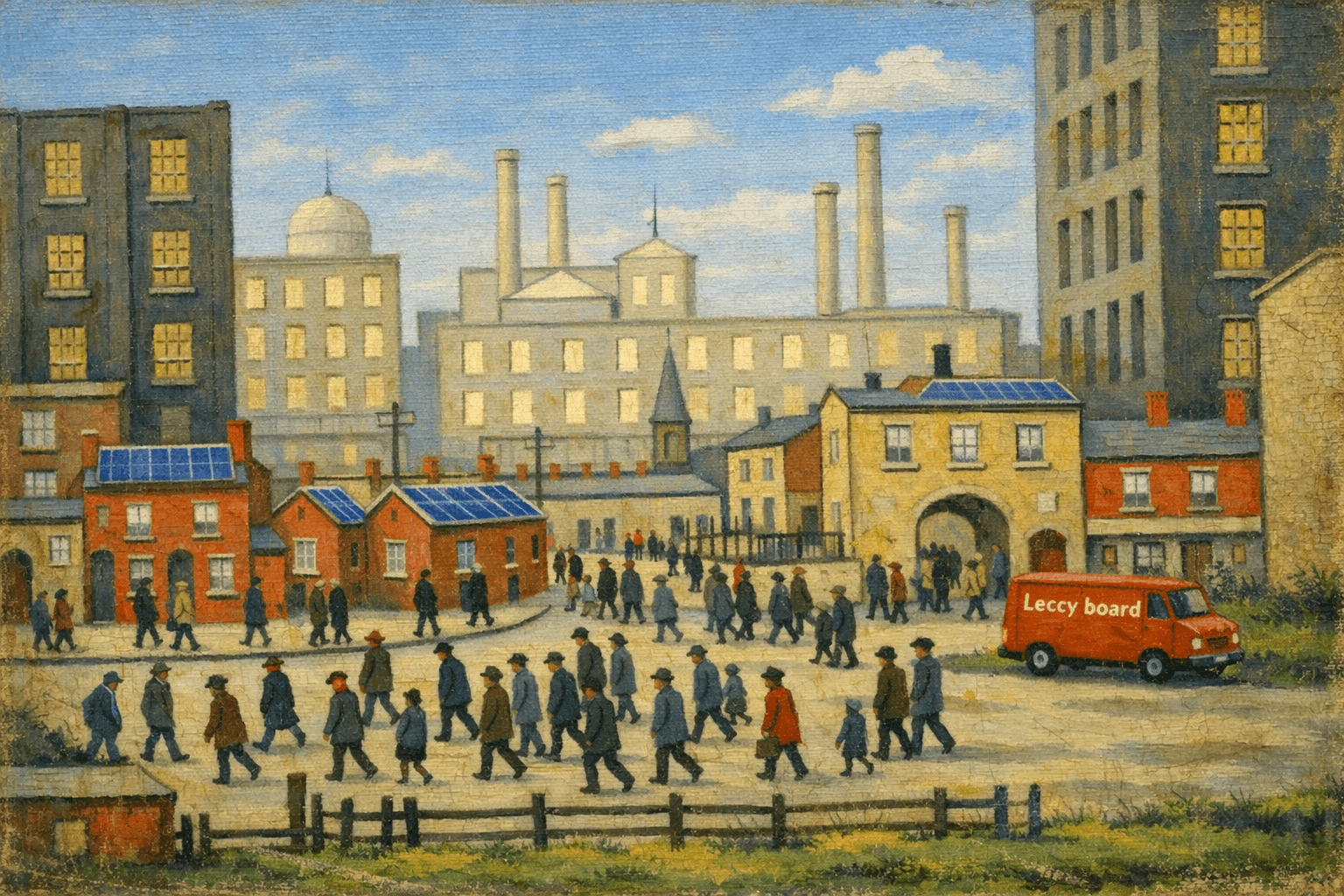
There is a popular narrative about the energy transition that goes something like this: decentralisation is the future, so centralisation must be the past. It is a compelling line, particularly for those who have not worked inside the machinery of either world. But it misunderstands the relationship between the two. We are not abandoning centralisation. We are building thousands of tiny generators – rooftop bees, that now fly daily into a landscape still anchored by a central hive that keeps the whole colony coherent.
The old electricity world functioned because the hive held its shape. It didn’t matter whether you were in Liverpool, Leeds or London, the pulse of the system was steady, communication was clear, responsibility was visible and lessons travelled. The hive allowed the workers to move quickly, safely and with purpose. Lowry felt that hum in his paintings, the steady movement of people who knew their role within a larger whole.
Today, our rooftops are filled with a new kind of worker: solar arrays generating their own pollen of clean energy. Every warehouse, every school, every commercial roof has become a foraging bee, gathering what it can from its own patch of sunlight. This is decentralisation at its best; local, agile, generative. But even the most industrious bee cannot survive without its hive. It needs a stable centre, a shared orientation, a structure that allows the colony to thrive rather than scatter.
Planning is the first clue to why the hive still matters. The grid cannot manage headroom, fault levels, reinforcement or stability if energy flows become completely unpredictable. The operators are not trying to hold decentralisation back; they are trying to hold the system upright long enough for decentralisation to flourish. Predictability is not an enemy of innovation, it is the condition that allows innovation to scale.
Protection follows the same logic. A rooftop system is never going to energise a dead grid, G99 anti-islanding sees to that but variability still influences voltage rise, harmonic behaviour and the subtle coordination margins that protection engineers rely on. The hive keeps the colony safe. It absorbs the risk so the bees can work freely without endangering one another.
Safety also cannot be decentralised. Authorisation boundaries, isolation rules, switching sequences – these depend on a single source of truth. This isn’t because contractors lack capability; on the contrary, they operate with extraordinary skill across an unpredictable landscape. It is because when consequences are measured in lives and system stability, ambiguity becomes unacceptable. The hive provides clarity, not control.
Standards play a similar role. Without a shared language, every rooftop becomes its own dialect. Documentation drifts. Maintenance practices diverge. Failures repeat quietly because no one outside that site can see the lesson. Standards are not a constraint on craftsmanship; they are what allow craftsmanship to be recognised and repeated. They let the best work ripple outward.
But none of this means decentralisation is replacing the wrong things. It is replacing exactly what should be replaced: the old idea that electricity must be produced far from where it is used and that consumers must be passive. What decentralisation offers is a colony-level transformation, thousands of bees harvesting energy at the edges, bringing resilience, speed and local empowerment. What it does not offer is a way to manage systemic integrity alone.
The future will not be a choice between hive or bees. It will be a hive sustained by thousands of rooftop bees, each one generating, sharing, and contributing to a system stronger than either model could achieve alone.
Contractors sit in the centre of this transformation. They are the ones building the wings of the colony – installing the arrays, solving the quirks of real-world roofs, diagnosing faults years after the original installer has vanished and stitching together the continuity that decentralisation depends on. If the hive keeps the system coherent, the contractors keep it alive. They are not peripheral to the transition. They are the transition.
Centralisation is not the enemy of decentralisation. It is the structure that allows decentralisation to avoid fragmentation. A colony does not thrive because every bee works independently. It thrives because every bee’s work is understood by the hive.
The real challenge of the next decade is building the pathways – the methods, data, standards and shared intelligence, that allow rooftop bees and the central hive to understand one another again. Lowry painted a hive moved by one rhythm. Today we are building a new outer ring of bees. The task now is helping both parts recognise they belong to the same colony.