
The period of change we are living through is extraordinary. The pace of innovation arriving through decentralised generation sometimes feels like a modern echo of the early days of electrification. Every few months, new technologies appear, footprints shrink, performance improves and costs fall. But unlike the old electricity boards who controlled everything up to the meter, this transformation is happening behind it. Entire industries are forming in real time. Business plans rise and fall on policy shifts. Contractors are navigating a market that is still being invented around them.
This level of progress is exciting, but it also creates blind spots and if we want the rooftop revolution to reach its full potential, we need to understand not nostalgically, but practically what was lost when the old centralised structure disappeared.
The first loss was coordination: Not coordination of individuals, but coordination of systems.
In the centralised era, there was one method, one standard, one training pipeline, one set of expectations and one framework for maintenance. Whether you were in Glasgow or Gloucester, the operational rhythm was recognisable. Today, each rooftop becomes its own interpretation of how a system should be built. Practices vary by contractor. Documentation varies by preference and pressure. O&M approaches vary by company culture, commercial constraints and workforce availability and because the data never looks the same twice, it becomes almost impossible to build consistent models for root-cause analysis or long-term asset performance.
This level of fragmentation is not the fault of contractors. It is the consequence of decentralisation arriving faster than its supporting framework.
The second loss was continuity: In the centralised world, even as people moved on, the method stayed put. Corporate memory acted as ballast, processes survived handovers and knowledge stayed in place.
In the decentralised world, continuity depends on two separate things happening perfectly nearly all the time: the installer must gather and hand over every key detail, and the asset owner must know enough and care enough to store it, update it and pass it forward. In practice, this rarely happens.
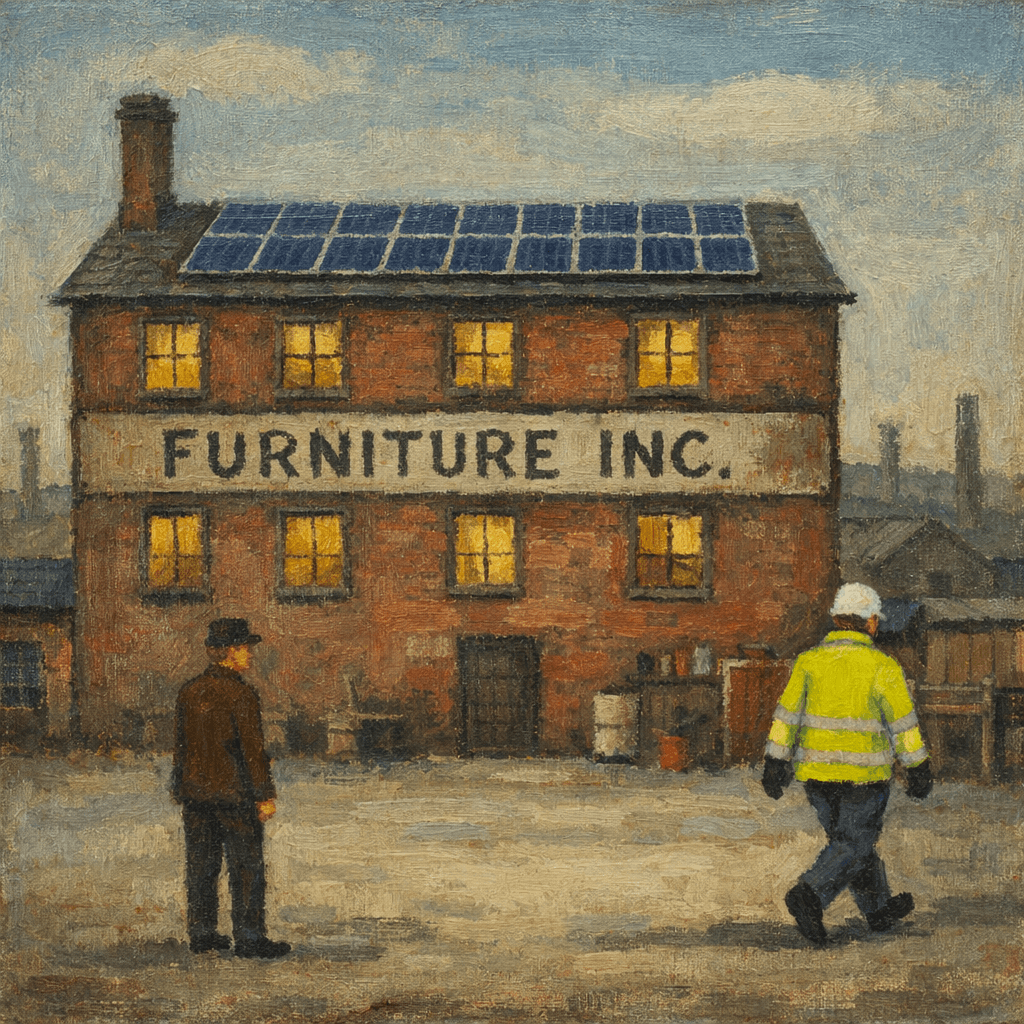
To see why, imagine a production manager in a furniture factory. Their world revolves around rotas, deliveries, safety, budgets and production targets not power engineering. They are tapped on the shoulder and told they’ve been given a “development opportunity”: a solar array is being added to the roof, and they are now responsible for “keeping on top of it.” Overnight they inherit a system they didn’t design, a document pack they didn’t request and responsibilities they were never trained for. Perhaps they stay long enough to maintain continuity. But what if they move departments? What if the company relocates? What if the handover consists of one rushed meeting and a folder stuffed in a drawer?
Multiply this scenario across more than 100,000 commercial installations in the UK and the fragility becomes obvious. Not because people are careless but because responsibility shifts too frequently for consistency to survive.
The third loss was accountability: Not the desire to take responsibility, but the ability to trace it.
In the centralised system, if something went wrong the network operator fixed it. Accountability had a single address. Today, responsibility disperses the moment a system is energised. If a fault emerges five years later due to an installation issue and the maintenance contractor is a different company, who absorbs the liability? And for how long? What if the original installer left the market, merged, or pivoted into another sector? The ambiguity is structural, not intentional. Contractors care deeply about their work but the system they operate within does not yet provide a clear chain of accountability.
The final loss was the discipline of doing things one way: Centralised systems deliberately suppressed variation because variation in a tightly coupled, safety-critical network introduces risk. Decentralised energy by contrast, thrives on innovation. New technologies appear constantly, new design philosophies emerge, new entrants join the market, new tools reshape workflows. To operate successfully, contractors effectively run two businesses simultaneously: one focused on securing and delivering new installations, the other on maintaining assets they may not have built, under conditions they did not define for durations that outlast most commercial cycles.
Having worked in depots where new-connections teams and faults-and-maintenance teams sat side by side, I can tell you that on paper they handled the same thing – moving electrical energy from A to B but the mindset required was completely different. The grid had room for both. The decentralised world often expects one business to embody both disciplines while navigating commercial pressures the old system never faced.
None of this is an argument against decentralisation. It is not doom and gloom, nor a call to resurrect a past that was suited to its era but not ours. Decentralised energy is not a flawed idea – it is an early one. Its challenges are not born of poor workmanship or a lack of care. They are born of structure that has not yet caught up with scale.
What we lost when we lost centralisation were not the advantages of monopoly, but the advantages of alignment: consistent methods, predictable training, a shared cultural memory, clarity of responsibility and data that travelled through a system rather than disappearing into a drawer.
The old world achieved alignment by default.
The new world must build alignment by design.
That is what this book and the thinking behind AutoWatt aims to explore: how to rebuild the scaffolding of reliability in a world where generation is everywhere, responsibility is dispersed and the hive is reforming itself one rooftop at a time. Contractors are not the problem, they are the pioneers. This transition succeeds only if we give them the structures, tools and shared language they deserve.