
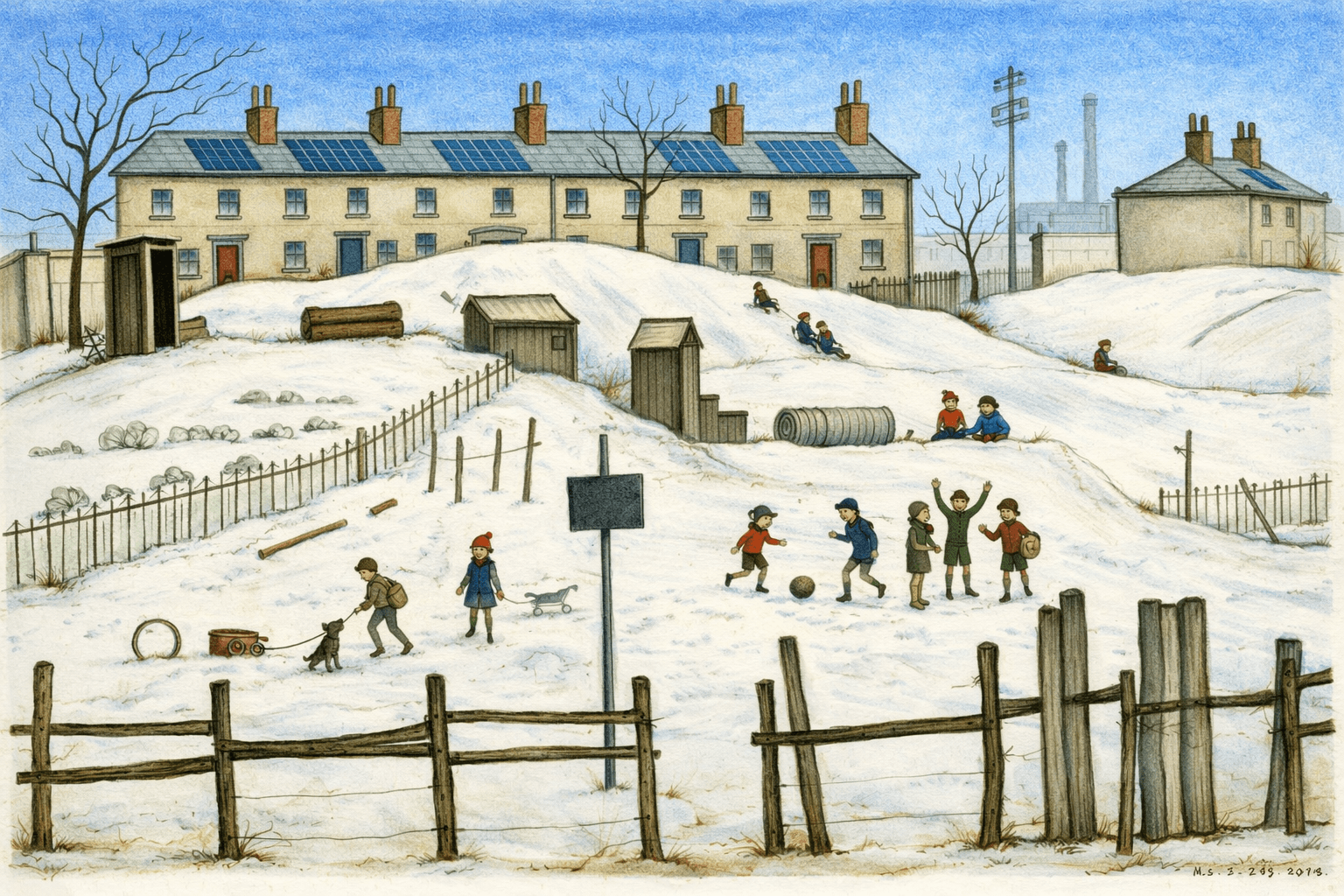
For much of the past decade, Britain’s social housing solar fleet has existed in a strange kind of operational darkness. Not literal darkness, because the systems kept generating and feeding homes quietly and consistently, but administrative darkness. The kind that builds slowly, invisibly, until one day someone opens the cupboard, checks the loft, or starts reviewing the files and realises how long it has been since anyone looked properly at the asset at all.
During the FiT boom, tens of thousands of rooftop systems were fitted across council estates and housing association stock. Installers moved quickly, funding windows moved even faster and by the time the rush subsided the wider landscape had changed. Subsidies shrank, contractors disappeared, staff moved on, departments restructured and asset registers drifted out of date. The culture moved on and for years afterwards, a vast fleet of solar assets continued operating with very little structured long-term oversight. Not deliberately mismanaged. More often simply unmanaged in the way any quietly functioning system is when the second half of the asset’s life was never clearly owned and in many cases, these systems were sold as “fit and forget”..
Solar allows that kind of neglect, at least at first.
It is quiet.
It does not demand attention every week.
It does not usually fail loudly.
It sits on the roof and gets on with its work.
But neglect has a clock and social housing is where that clock is now starting to show.
As the first wave of FiT-era systems reaches eight, ten, twelve and in some cases fourteen years old, the sector is beginning to see what a decade without structured oversight actually looks like. The findings are rarely theatrical, but they are remarkably consistent. Inverter fleets have moved into the end-of-life window, DC cabling in lofts has often been left unsupported and protection arrangements no longer line up with current expectations. Fire detection integration is absent. Some systems are affected by shading that was never properly revisited. Others are still operating, but without anyone being able to say with confidence when they were last inspected, to what standard, or with what result. These are not dramatic discoveries. They are the sort of ordinary, cumulative issues that appear when assets age in silence.
That is what ten years of neglect usually looks like in practice.
Not collapsed systems.
Not blackened walls.
Not some cinematic failure scene.
It looks like unsupported DC runs in loft spaces. It looks like older inverters still hanging on, even as replacement becomes increasingly inevitable. It looks like RCD arrangements that are now non-compliant, surge protection that was never fitted and records that stop at commissioning. It looks like one property with significant shading, several more with lesser impact and a portfolio that still appears broadly functional from the outside even while its margin of confidence is steadily eroding.
The physical condition of the systems is only half the story. The other half lives in filing cabinets, shared drives, inboxes, legacy folders, and half-complete handover packs. Social landlords did not always inherit badly documented systems. In many cases, the documents were handed over. The problem was continuity. In decentralised energy, information rarely lands with one permanent owner. It might go to a clerk of works, a sustainability lead, a housing officer, a caretaker, an electrician, a development manager, or a contractor who is no longer involved three years later. Multiply that by thousands of properties, changing internal structures, outsourced maintenance models and evolving teams and the problem becomes obvious: the information was not always lost. It was scattered.
When responsibility is distributed across too many hands, it becomes owned by no one.
This is the quiet truth revealed by the first generation of social housing solar. Landlords assumed the installer would return if needed. Installers assumed the landlord would ask if something mattered. Contractors assumed someone upstream had an asset strategy. Individuals changed jobs, portfolios changed shape, and organisational memory faded. Slowly, subtly and usually without malice, a decade passed with no shared national method for what long-term care of these systems should actually look like.
But when no one owns the history of a system, no one really owns its future.
The most striking lesson is not that these systems are inherently fragile. It is that early compromises and overlooked details become embedded when nobody goes back to check. A system installed well but never revisited gradually drifts out of confidence. A system installed imperfectly and then ignored carries those weaknesses quietly into mid-life. The issue is not usually one dramatic fault. It is the accumulation of small uncertainties: cabling support, protection coordination, asset age, documentation gaps, inspection history, performance visibility. None of these necessarily feels urgent in year one. But by year ten, together, they begin to shape the risk profile of the whole estate.
That is what social housing now reveals so clearly. It is not a cautionary tale about solar as a technology. It is a cautionary tale about structure. It shows what happens when a national wave of decentralised generation is delivered without an equally durable method for inspection, record keeping, lifecycle planning and periodic review. It shows how easily continuity dissolves when a 25-year asset is managed through five-year organisational cycles. It shows that the real vulnerability in decentralised energy is not the panel on the roof. It is the absence of a long-term system around it.
Most importantly, it shows that the real consequences do not appear in the first years after commissioning.
They appear later – after subsidy, after handover, after the installer has moved on, after the original documents have been buried in an archive and after the people who first understood the system have left the organisation. That is when the second life of the asset begins. That is the moment many housing providers are now entering.
If this can happen in social housing, with central landlords, defined stock and theoretically clearer lines of responsibility, then the warning for the wider built environment is obvious. Warehouses, schools, hospitals, factories, retail estates, farms, commercial rooftops – the same pattern exists wherever decentralised assets were installed quickly and then left to run without a durable standard of care.
What social housing offers is not a warning against solar.
It is a warning against assumption.
Against assuming that generation equals health.
Against assuming that quiet means safe.
Against assuming that because a system still works, it is still known.
The second decade of decentralised generation does not need to repeat the first. But it will, unless something changes. A method. A framework. A consistent standard of inspection. A way for systems to remain visible even as organisations change around them. A way to turn dispersed assets into managed assets.
This chapter is not really about the past.
It is about the opportunity the past reveals.
None of this means an older system is beyond recovery. It means the starting point has changed. Where continuity once existed, assessment must now replace assumption. Where records are fragmented, condition must be re-established. Where confidence is low, method must fill the gap. The work becomes slower, more deliberate, and more structured. You inspect what has gone too long without review. You map what can no longer be taken for granted. You separate safety-critical works from lifecycle replacement and lifecycle replacement from optimisation. You rebuild the story of the asset so that future decisions are based on evidence, not guesswork.
That is the opportunity hidden inside a decade of neglect.
Because the next generation of rooftops and the first generation still worth protecting deserves something the market largely failed to provide the first time around:
not just installation,
but continuity.