
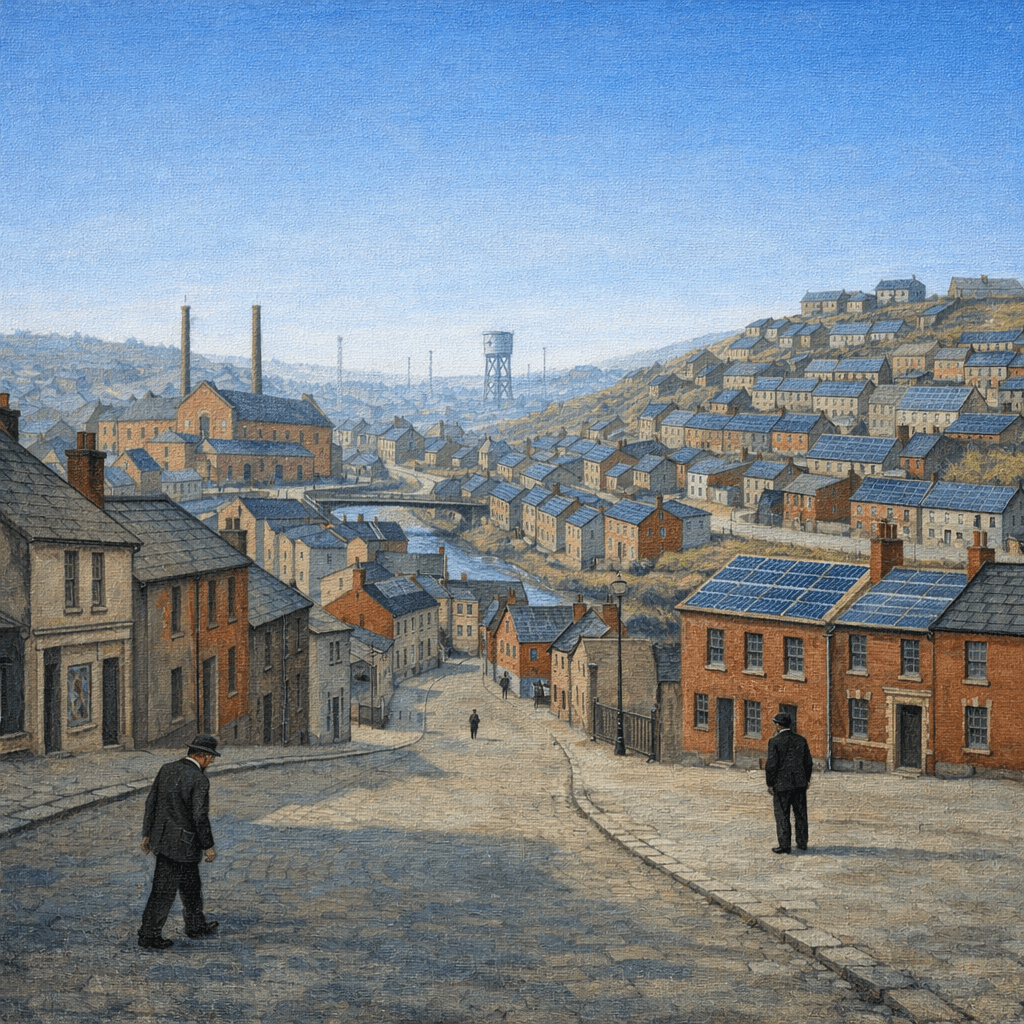
If you spend enough time walking rooftops built during the Feed-in Tariff years, you begin to notice a peculiar kind of silence. The panels still generate, the inverters still hum, the kilowatts still arrive with dependable rhythm. But the systems themselves carry no story. There is no trace of who designed them, no clear record of who installed them, no lineage describing the decisions that shaped them. They are technically alive but historically orphaned – power stations with no parents.
This wasn’t because installers of that era failed to document their work. In truth, many of them produced immaculate handovers. Some issued thick binders with schematics and photos. Others supplied neat digital packs on branded USB sticks. A few did both. By the standards of the time, the documentation was often thoughtful and complete. The engineering wasn’t the problem.
The problem was what happened next.
A decentralised asset is only as durable as the person who becomes responsible for it after the installer walks away and here, the rooftop world collided with a reality it was never designed to handle. The electricity boards had the luxury of continuity: one organisation, one set of depots, one culture, one lineage. Solar had none of that. Instead, every commissioning pack was handed to a different type of custodian – facilities managers, estate teams, external landlords, general office staff, tenants, managing agents, company directors, operations teams, building buyers and occasionally nobody at all.
A pack might be filed carefully.
Or left in a drawer.
Or saved on a server that no longer exists.
Or carried from building to building in the boot of a car.
Or handed over during a rushed resignation.
Or overwritten during an IT migration.
Or left on a USB stick that new IT security policies no longer permit anyone to plug in.
Nothing dramatic. Just small, almost invisible acts of drift.
Decentralisation didn’t lose its memory through neglect. It lost its memory through variability, too many potential recipients, too many organisational changes, too many handovers conducted by people who could not possibly understand the long-term consequences of misplacing a single folder. Across ten or fifteen years, the documentation splintered. The story of each system broke into fragments no one could piece back together.
And then maintenance teams arrived to inherit the silence.
Ask any contractor who maintains a decade-old commercial system and they will tell you the same story: the system works, but its past is missing. They are asked to steward something without ever being shown what it once was. Some arrive to paper packs that have survived beautifully; others to a single faded page; others to nothing at all. The installer may have folded years earlier. The facilities manager who received the original pack may have left. The building may have changed owners twice and as for the commissioning data – IR results, polarity tests, torque logs, string maps, serial numbers, design assumptions, it often evaporated into the churn of time.
None of this is the contractor’s doing.
All of it becomes the contractor’s problem.
Without a system’s biography, you cannot know whether it is merely old or quietly unsafe. You can inspect what is visible, certainly, but the invisible elements, the ones that matter most – are the ones documentation was meant to preserve. You cannot see whether a termination was torqued correctly twelve years ago. You cannot infer the designer’s assumptions. You cannot guess whether a DC isolator has been operated since the day it was installed. Risk, in orphaned systems, lives in the margins between what can be seen and what can no longer be remembered.
Yet the solution is not to rebuild history, it is to rebuild certainty. None of this means an orphaned system is beyond recovery, it means the starting point has changed. Where continuity once existed, assessment must now replace assumption. The work becomes slower, more deliberate, more forensic. You test what you cannot trust. You map what you cannot inherit. Orphaning does not demand abandonment; it demands method.
In practice, that means a pragmatic form of re-commissioning:
active insulation monitoring to watch for the slow creep of breakdown;
replacing any DC isolator that has sat untouched for years; performing a targeted torque audit and expanding wherever issues appear;
establishing a photographic and serial-number baseline;
mapping strings properly;
replacing or upgrading safety mechanisms where appropriate;
and creating, at last, a digital biography that will survive every future handover.
When memory disappears, method must take its place.
But the consequences extend further than individual rooftops. They stretch invisibly into the distribution network itself. The grid does not rely on rooftop systems to be perfect; it relies on them to be predictable. Over time, planners absorb their behaviour into the logic of the network. If an industrial estate consistently offsets twenty per cent of its load through rooftop solar, the grid naturally incorporates that pattern into reinforcement decisions. It may choose not to upgrade a transformer because the estate has demonstrated ten years of stable generation.
But decentralised systems can fail quietly and they can fail together.
Imagine a cluster of systems installed by the same company during the FIT years. Ten years later, the company no longer exists. The handovers are lost. Maintenance has been sporadic or absent. Then, as components age, those systems begin failing within months of each other: seized isolators, declining insulation resistance, degraded connectors, mismatched replacements, or inverters drifting slowly towards end-of-life. The estate stops behaving the way the grid expects. Load rises without warning and a network that made rational decisions based on a decade of observed performance must suddenly absorb a burden it had no reason to anticipate.
This is not the DNO’s blind spot.
It is decentralisation’s blind spot – a structure that places long-term network assumptions on assets with short-term documentation cultures.
FIT orphans are not a moral failing. They are a structural one. They show us the reality of a young industry that grew faster than its capacity to steward its own lineage. What vanished wasn’t competence. It was continuity. The engineering was sound; the memory was scattered.
And yet there is a lesson here – one that reaches beyond FIT-era rooftops.
In the centralised world, documentation belonged to the organisation.
In the decentralised world, documentation belongs to whoever happens to receive the handover that day. If we want decentralised energy to behave like a coherent hive rather than a scattering of solitary bees, we must give it a shared memory – one that outlives personnel, ownership, reorganisation, IT policy, and the physical fragility of paper, USB drives and half-forgotten server folders.
Generation lasts twenty-five years.
Installers don’t.
Facilities managers don’t.
Occupiers don’t.
USB ports certainly don’t.
The future belongs to the systems that remember themselves.
Our task now is to build the memory they were never given.