One of the most overlooked strengths of the old electricity boards had nothing to do with their budgets, their branding or their organisational charts. It lived in something quieter, almost invisible unless you had worked inside it: the way the system learned. When something went wrong in one part of the country, it seldom stayed local. A fault in Liverpool could shape a procedure in Leeds; a near-miss in London could influence training in Glasgow. Not because the boards were a single monolithic organisation, they weren’t, but because they were knitted together through habit, collaboration and the forums that held the industry together. The Electricity Networks Association acted as a kind of shared memory centre, a place where patterns became visible long before they turned into risks.
That doesn’t mean the old system was perfect. It means it was connected and that connection created a form of resilience that the modern decentralised world has not yet managed to replicate. Contractors today are not weaker than the old boards; if anything, they shoulder more responsibility with fewer structural supports. What the boards enjoyed was not superior competence, but superior linkage: when one person learned something, everyone eventually learned it.
That principle was never more visible than when something serious happened. If there was a major incident like a disruptive failure, an injury, a piece of equipment behaving outside expectation, a formal panel of inquiry was launched. Operations sat alongside health and safety, asset management, control engineers and senior leadership. They would gather evidence, reconstruct the sequence of events and identify not only what went wrong but why the system had allowed it to happen. The findings were shared with the Health and Safety Executive. If the inquiry uncovered lessons that might prevent future harm, those lessons fed straight into the established working groups, were distilled into clear guidance and then disseminated through team briefs and the notice boards of depots across the country. A single event could change the behaviour of thousands. That was the power of shared failure.
The culture around everyday faults reinforced the same instinct. Liverpool and London, for example share a similar type of interconnection at both 11kV and low voltage. When a type of LV equipment or a particular switchgear arrangement behaved strangely in one location, the phone call to check whether anyone else had seen the same thing happened. Patterns were spotted not through software, but through conversation. The speed with which information travelled wasn’t hierarchy; it was reflex. The moment a fault hinted at something unusual, engineers wanted to know whether it was an isolated quirk or the beginning of a wider trend.
Now imagine applying that instinct to today’s solar landscape. A strange inverter noise in a warehouse in Bristol. A DC connector overheating on a distribution centre in the Midlands. A structural weak point discovered on a school roof in Leeds. Does the insight reach anyone beyond the person who found it? Does another contractor two hundred miles away have any visibility of the early warning signs? Would a similar failure on a similar system trigger investigation, comparison or a coordinated response? In most cases, the answer is simply no. The learning dies where it occurs. The next contractor meets the same issue blind, and the pattern begins again.
Documentation was another quiet strength of the old system. Every fault, however small, generated evidence: test results, sketches, memos, photographs, signatures, diagrams, handwritten logs. These weren’t bureaucratic rituals, they were inheritance. They meant the next engineer arriving on site could trace the story of the asset: its health, its history, its weaknesses, its temperament. In decentralised energy, many failures leave barely a ripple. Not because contractors are careless, far from it, but because the environment doesn’t reward or require the preservation of that memory. Without consistent documentation, lessons cannot travel. Without travel, learning cannot accumulate. Without accumulation, reliability becomes an accident rather than an outcome.
The electricity boards were resilient not because they were centralised, but because they were synchronised. They treated failure as a collective learning event, not an individual flaw. Responsibility was shared and so was improvement. A weakness discovered in one corner of the country strengthened the entire network. Today’s contractors are often expected to operate alone, without access to the pooled knowledge that once protected an entire industry.
This is not a contractor problem. It is a system design problem.
If decentralised energy is to mature, it must rebuild the capacity to learn as one. The old world achieved this through culture, proximity and long careers. The new world must achieve it through design: through shared datasets, compatible documentation, aligned classifications of failure, consistent testing methods and digital infrastructures that allow one rooftop to benefit from the lessons learned on another.
Contractors are doing the hardest part of this transition – building, maintaining and troubleshooting hundreds of thousands of micro power stations without the benefit of a shared memory or a stable framework. They are not the weak links of decentralisation; they are the ones preventing fragmentation from becoming systemic. But they cannot be expected to hold the system together alone.
If every rooftop is its own small power station, then every rooftop deserves to benefit from the failures and the successes, experienced across the whole industry. The strength of the old world was that lessons travelled faster than mistakes. The weakness of the new world is that mistakes travel and lessons often don’t.
The future of decentralised energy will depend on reversing that pattern.
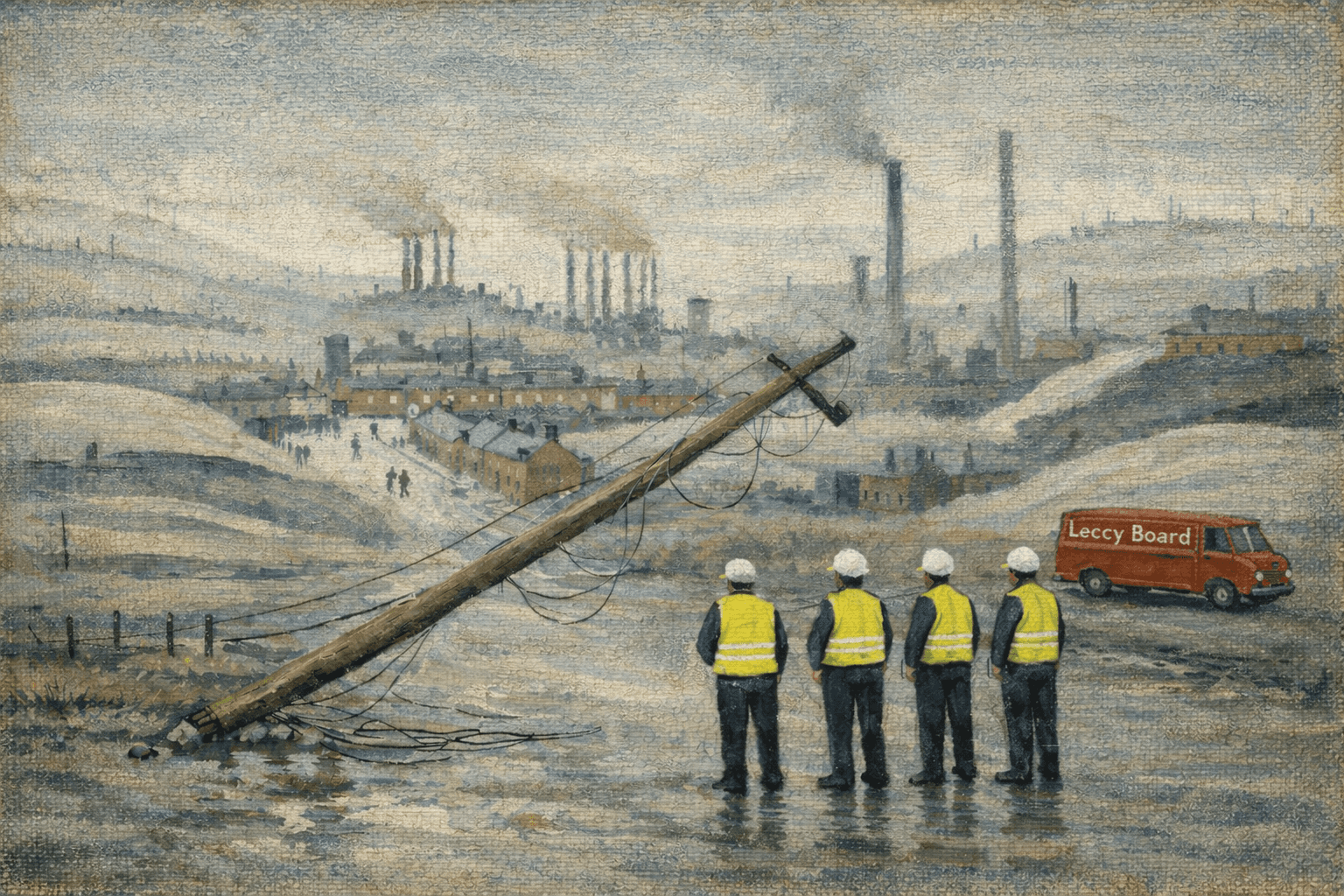
Only when a fault on one site strengthens ten thousand others will we have built a decentralised hive worthy of the one Lowry painted, alive not only with activity, but with coherence.