
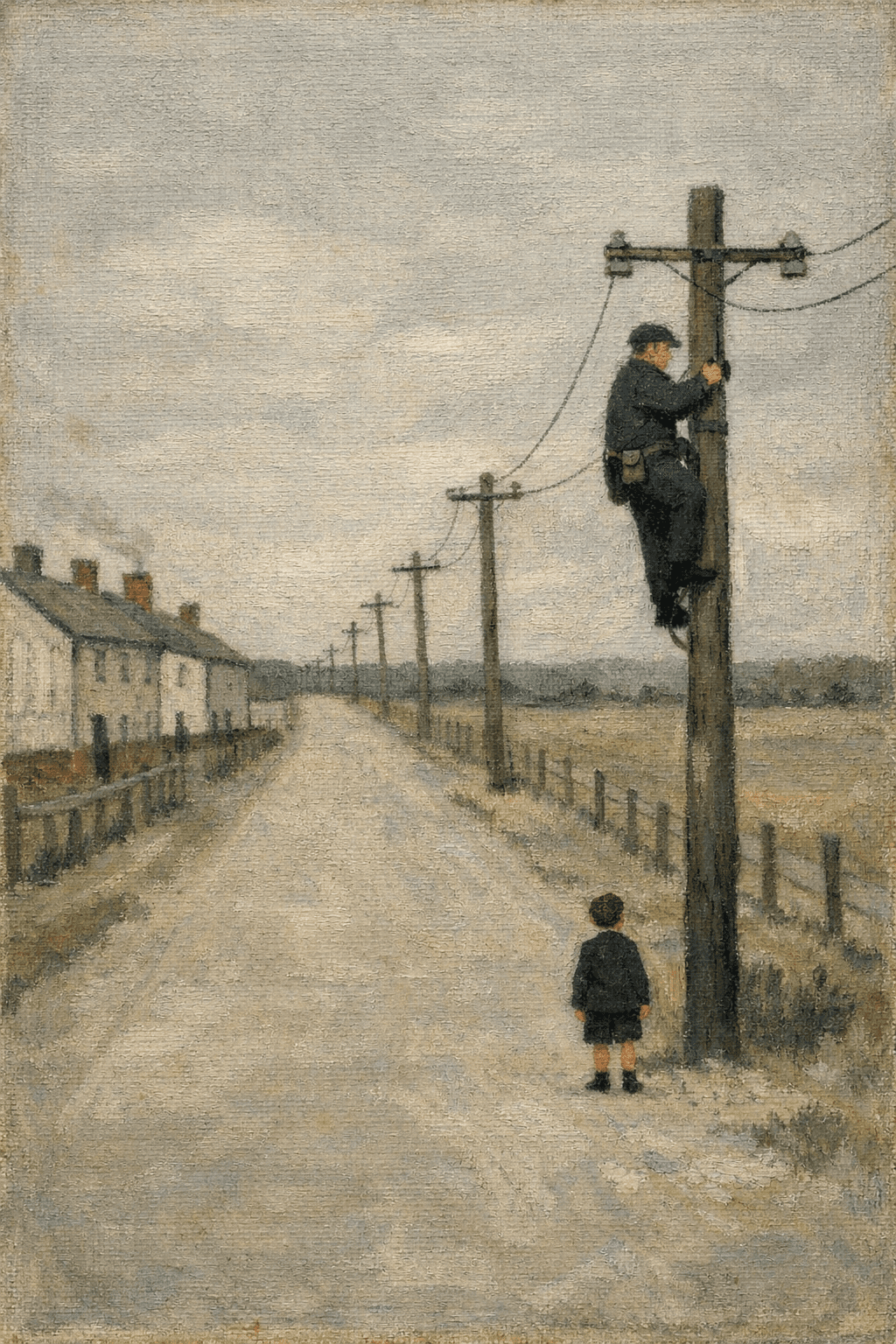
For most of the last century, working in energy wasn’t simply employment; it was identity. People joined the electricity boards straight from school, trained with the same crews for decades and often handed the baton to their children. Whole depots became extended families; in parts of Liverpool you could swear the entire lines team shared a surname. None of this was glamorous and none of it was fast, but it created something the decentralised world now quietly misses: continuity. Not continuity of employment – continuity of memory, method and meaning.
Contractors today work in an entirely different landscape. Their environment is commercial, competitive, margin-sensitive and relentlessly fast. They live and die by customer acquisition, cashflow discipline, and their ability to assemble competent teams at the right price, at the right moment, for the right job. Yet despite operating in a far harsher environment than the electricity boards ever did, they are expected to deliver decades of reliability on assets that may sit on a roof until today’s apprentices are middle-aged. The pressure is immense and it is rarely acknowledged.
This chapter is not a romantic tribute to the old world, nor is it a critique of the new one. It is an attempt to understand why the old system possessed certain strengths and more importantly, how we can build modern equivalents that support the contractors who now carry the responsibility of making decentralised energy work. Because contractors are not the weak link in this transition. They are the ones holding the entire transition together. What they lack is not competence. What they lack is the structural support the old world took for granted.
In the centralised era, competence compounded because the context held still. A technician might spend twenty-five years switching, isolating, fault-finding and maintaining the same patch of network. Deep expertise accumulated almost accidentally: the same cables, the same substations, the same faults reappearing like familiar characters in a long-running play. By contrast, rooftop and commercial solar work is built on motion. Contractors rarely have the luxury of staying within a single geography or discipline. They chase tenders across regions, pivot from installation to maintenance, adapt to new technologies, regulations and connection rules and respond to customers who expect perfection at the pace of retail. Projects last weeks, not careers. In many ways, it is extraordinary how well contractors perform despite the lack of a stable field to grow deep roots in. The issue is not that decentralised systems lack competence; it is that they lack the conditions that allow competence to compound. This is not the contractor’s fault, it is a system design gap.
The second gap emerges in culture. Knowledge in the old electricity boards wasn’t merely procedural - it was cultural. Depots trained their own. Lessons were retold. Safety norms were inherited. Stories of past failures travelled faster than memos. Accountability didn’t need to be invented because everyone already understood how the hive worked. Contractors operate in a culture shaped by turnover, subcontracting, seasonal workforce fluctuations, shifting project teams and constant commercial pressure. When the cast of characters changes every year, cultural memory struggles to take hold. Yet contractors are still expected to deliver DNO-level reliability on assets scattered across thousands of rooftops, often inheriting systems where documents are missing, commissioning data is incomplete, responsibilities are ambiguous and the original installer has long since disappeared. This is not a contractor problem. It is a system problem. We placed decentralised responsibility into an environment built on short cycles and thin margins and then acted surprised when continuity dissipated.
The third loss is the most invisible: tacit knowledge. In the centralised world, quiet memory was one of the strongest forms of reliability. When you work the same patch for long enough, you accumulate insights no manual ever captures: which substations flood, which joints are temperamental, where cables really run beneath streets, how certain assets misbehave in certain seasons, what a designer thirty years ago was probably thinking. This knowledge prevents failures before they appear. In decentralised energy, no comparable structure exists. No one spends a lifetime maintaining the same set of rooftop systems. Responsibility moves with contracts, budgets, acquisitions and convenience and every time responsibility moves, memory dies with it. Contractors everywhere feel the consequences: inheriting systems with missing drawings, absent serial numbers, mismatched components, undocumented tests and a customer who genuinely believes the system should be “set and forget.” It is not a competence gap they are bridging; it is a continuity gap.
The fourth shift is philosophical. In the old world, reliability was tied to identity; in the new world, it is tied to transactions. That does not mean the new world is worse; it means the incentives are different. Contractors operate in a brutally competitive ecosystem where survival comes before purity of process. They juggle customers, cashflow, supply chains, staffing, training costs, insurance burdens, compliance obligations and the entire volatility of being a small or medium-sized business in a rapidly changing sector. Expecting them to replicate the deep structural memory of a 50-year centralised monopoly is unrealistic – unless we give them tools and frameworks that make that expectation achievable.
This brings us to the heart of the matter. The rooftop revolution will only succeed if reliability becomes a feature, not an accident. But reliability is not created by heroism or goodwill. It is created by method, standardisation, structured training, predictable competence, shared rules and cultural alignment. These qualities were once provided by long careers. They must now be provided by deliberate system design. The decentralised world depends on contractors, but it has not yet been designed to support them.
The future of decentralised energy will not recreate the employment model of the past. But it absolutely must recreate the conditions that allowed the old system to work: continuity without lifelong tenure, memory without static teams, clarity without rigid hierarchy, reliability without bureaucracy, competence without heroic effort. This chapter is not a criticism of contractors. It is a defence of them. The old world had structural advantages the new world does not and contractors have been asked to deliver the same reliability without any of that scaffolding.
The chapters that follow explore how we rebuild that scaffolding not to constrain contractors, but to empower them. Not to recreate the past, but to give the present the tools it deserves. With the right methods, the right standards and the right support, decentralised energy can move from a marketplace of isolated projects to a coherent, reliable ecosystem. The people who will make that possible are the same people climbing the ladders, driving the vans and keeping these systems alive today.